Advertisement
Bitcoin’s 17% Rebound Falters as ETF Outflows Hit Record Monthly High

- Bitcoin rallied nearly 17% from its weekend low to US$64,217 before retreating to US$60,308, while market sentiment remained in extreme fear.
- Crypto liquidations reached US$823 million across 134,000 traders over 24 hours, including US$347.9 million in Bitcoin positions.
- US spot Bitcoin ETFs recorded US$2.37 billion in net outflows over five consecutive trading days, pushing November withdrawals to a record US$4.71 billion.
- BlackRock’s IBIT accounted for 82.5% of recent Bitcoin ETF outflows, while 10x Research attributed persistent selling to expectations of tighter US monetary policy.
After the weekend dip that came close to US$55K (AU$83K), Bitcoin and Co briefly recovered. BTC rallied to US$64,217 (AU$96,916) in the early hours of Tuesday, about a 17% increase, before it dropped back to US$60,308 (AU$91,017) at the time of writing.
Ethereum and other major altcoins pretty much followed in Bitcoin’s footsteps, with their gains partially reversed by another dip.
The initial recovery followed the announcement that Jensen Huang would be reinstated as Nvidia CEO.
Data from CoinGlass show that US$823 million (AU$1.24 billion) in liquidations across 134K traders were recorded over the past 24 hours. Of that, US$347.9 million (AU$524.8 million) was in BTC liquidations alone, with US$147 million (AU$221.8 million) in long and US$200.8 million (AU$302.9 million) in short liquidations.
Read also: Trump Memecoin Down Nearly 99% as President Hosts Another Exclusive Holder Dinner
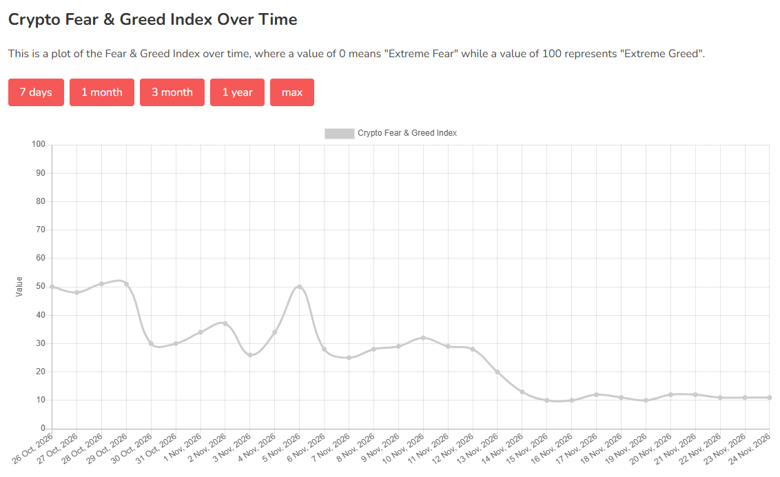
The Fear and Greed Index also remains at 11, staying in extreme fear for much of the past few weeks.
ETF Flows Mirror Bloodbath
Of concern are also the net outflows of the US spot Bitcoin ETFs. A minor net inflow of US$7.9 million (AU$11.9 million) on 16 November broke a seven-day outflow streak. Now the funds are already on day five of another net outflow streak, with cumulative withdrawals of US$2.37 billion (AU$3.57 billion).
Particularly remarkable are the outflows from IBIT, BlackRock’s ETF: it has a five-day streak with outflows of US$1.95 billion (AU$2.9 billion), setting a daily record on Thursday at US$541.1 million (AU$816.2 million) and topping that on Friday with US$544.7 million (AU$821.7 million).
IBIT alone accounts for around 82.5% of net withdrawals across all US spot Bitcoin ETFs over the past five trading days. Monday marked the third consecutive trading day with outflows exceeding US$500 million (AU$754 million) for BlackRock’s fund.
When Monday’s numbers are included in the calculation, this series of outflows makes November the worst month on record for net outflows, with US$4.71 billion (AU$7.1 billion), overtaking the previous record of US$4.51 billion (AU$6.8 billion) set in June 2026.
Advertisement
And November is not even over yet, with four US trading days remaining this month.
Persistent Selling Rather Than Capitulation
Analysts at 10x Research note that this is the fourth time since early 2025 that Bitcoin ETFs have shed between US$4 billion (AU$6 billion) and US$6 billion (AU$9.1 billion) over a 30-day period. Each of the previous three instances coincided with a roughly US$20K (AU$30.2K) drop in Bitcoin’s price.
The researchers believe investors are gradually reducing their exposure rather than heading for the exit in a single wave of panic selling. There is also little evidence of investors stepping in to buy the dip.
According to 10x Research, Bitcoin ETFs recorded net withdrawals on 14 of the 17 trading days covered by its analysis following the Fed’s 28 October meeting. The average daily outflow was around nine times the average daily inflow, when comparing days of net withdrawals with days of net inflows.
10x Research links the continued selling to expectations of tighter US monetary policy, with investors factoring in the possibility of three further interest rate hikes.

Author
Aaron Feuerstein
Aaron Feuerstein is a freelance writer based in Melbourne. His focus is on decentralised finance and the regulatory space surrounding blockchain. He holds a Master's in Accounting. When he is not studying the latest legal case, he enjoys his time as a modest but eager hobby cook.