Advertisement
Strive CEO Says Binance Hack Doesn’t Change Bitcoin Investment Case

- Strive CEO Matt Cole dismissed concerns over the Binance hack, comparing it to a bank robbery rather than a failure of Bitcoin’s underlying blockchain.
- Cole argued that digital credit allows Strive to amplify Bitcoin exposure without conventional debt or margin calls while positioning against fiat currency depreciation.
- Bitcoin fell from nearly US$82K to around US$76K following the Binance hack, while Brazil’s Mercado Bitcoin reportedly lost US$48.5 million in a separate incident.
- Strive and Strategy continued accumulating Bitcoin despite market weakness, while US spot Bitcoin ETFs recorded heavy outflows on Friday.
Despite recent turbulence in the crypto market, not everyone is focused on short-term price movements. Bitcoin bull and Strive CEO Matt Cole spoke about his long-term views about Bitcoin on the Chain Reaction podcast.
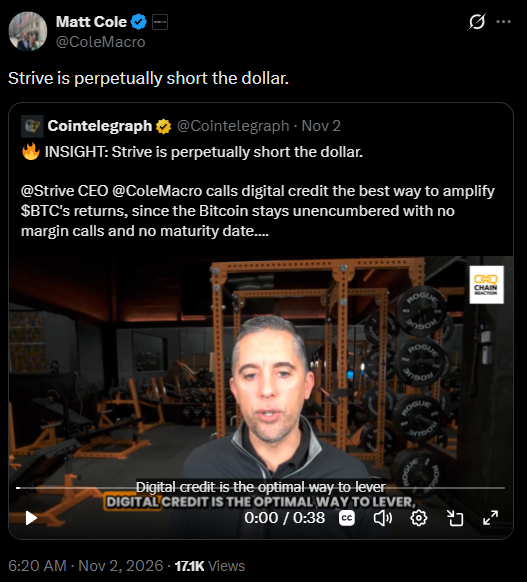
He brushed off concerns over the recent Binance hack as something that doesn’t make Bitcoin less investable. Cole compared the hack to a bank robbery, stressing it’s not a blockchain failure.
I do have conviction that over any reasonable time frame, this does not change the investment thesis on Bitcoin.
 Strive CEO Matt Cole
The CEO said the market was currently in early spring, adding that digital credit allows Strive to amplify its Bitcoin returns without taking on conventional debt, pledging Bitcoin as collateral or facing margin calls. He sees perpetual preferred shares as a way to benefit from Bitcoin’s long-term potential while positioning the company against the continued depreciation of fiat currencies.
It’s like the best thing you could do as a Bitcoin maxi fiat bear, right, is to make a perpetual trade of being short it.
Strive CEO Matt Cole Over the weekend, the FBI attributed the Binance hack to a North Korean hacking group. Meanwhile, Mercado Bitcoin, which is the largest crypto exchange in Brazil, also suffered a security incident, with around US$48.5 million (AU$69.5 million) reportedly stolen, according to blockchain analytics firm Bitquery.
Related: Hyperliquid Surges 17% After NYSE Owner ICE Strikes Deal for Regulated US Perpetuals
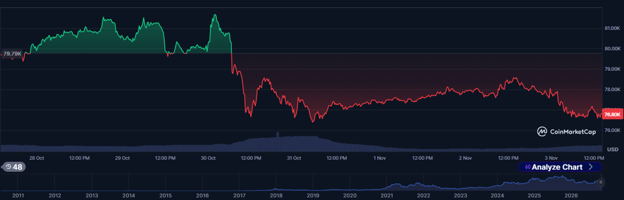
Following the Binance hack, markets dipped, and Bitcoin fell from just under US$82K (AU$117.5K) to around US$76K (AU$108.9K) and then stabilised somewhat. At the time of writing, it had dropped another 2.3% on the 24-hour chart and was trading at US$76.8K (AU$110K).
Treasuries Buy While ETFs Bleed
This comes as Cole’s Strive bought another tranche of BTC, inching closer to the second spot it wants to occupy among Bitcoin treasury firms. Saylor’s Strategy also made a Bitcoin purchase after a one-week pause.
Meanwhile, US spot Bitcoin ETFs recorded significant outflows on Friday, ending an otherwise positive week with a net outflow. US$643.2 million (AU$921.7 million) exited the funds that day, the largest single-day outflow since 25 June, when US$691.7 million (AU$991.3 million) in net outflows were recorded.
Figures for Monday were still incomplete at the time of writing, with Fidelity’s FBTC the only fund to have reported a non-zero flow.
Both Farside and Coinglass show US$6.7 million (AU$9.6 million) in net inflows for Fidelity’s FBTC – not a trend reversal just yet, but a positive sign for the fund, nevertheless.
Advertisement
Read more: Researchers Find AI Agents Can Bypass Crypto Spending Limits

Author
Aaron Feuerstein
Aaron Feuerstein is a freelance writer based in Melbourne. His focus is on decentralised finance and the regulatory space surrounding blockchain. He holds a Master's in Accounting. When he is not studying the latest legal case, he enjoys his time as a modest but eager hobby cook.