Advertisement
StarkWare Mines Bitcoin’s First Quantum-Safe Transaction on Mainnet
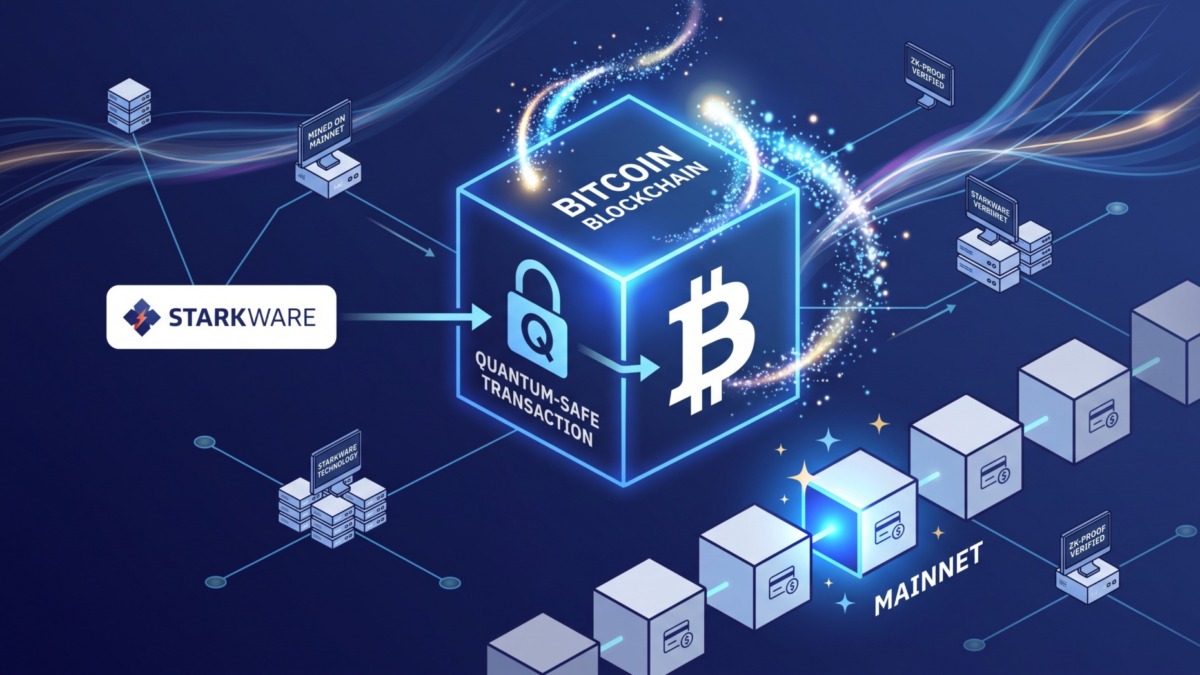
- StarkWare announced Wednesday that a transaction using its Quantum Safe Bitcoin (QSB) method was confirmed in block 964,199, mined by MARA Pool at 8:48 p.m. UTC.
- QSB, designed by StarkWare researcher Avihu Levy, uses “signature grinding” to rest security on hash functions instead of the elliptic-curve cryptography a quantum computer could break.
- StarkWare says QSB does not make Bitcoin itself quantum-safe, and CEO Eli Ben-Sasson still wants and expects a protocol-level soft fork.
StarkWare says it has run the first quantum-safe Bitcoin (BTC) transaction on mainnet, a spend confirmed in block 964,199 on Wednesday that is designed to shield the moved coins from future quantum attacks without changing Bitcoin’s consensus rules.
Chain data from Mempool.space shows the transaction combined inputs of 39,179 and 10,000 satoshis into a single 44,000-satoshi output, paid 5,179 satoshis in fees and was mined by MARA Pool at 8:48 p.m. UTC on Aug. 26.
QSB transactions use a nonstandard format that ordinary nodes will not relay, so StarkWare submitted the spend directly to the miner through MARA’s Slipstream service.
Read more: US Community Banks Unite to Build Nationwide Blockchain Network
Grinding for a Valid Signature
The method, called Quantum Safe Bitcoin, was designed by Avihu Levy, researcher and general manager of applications at StarkWare, who published the technique and an open-source repository in April.
It relies on what the firm calls signature grinding: searching off-chain for a spending transaction whose hash is itself a validly formatted signature, so the spend’s security rests on the hardness of inverting a hash. StarkWare engineer Tomer Giladi is continuing the work, the announcement said.
Bitcoin’s standard signatures depend on elliptic-curve cryptography, which Shor’s algorithm could solve quickly on a sufficiently large quantum computer, StarkWare noted. Levy told trade publication The Quantum Insider the method adds “a second lock that a quantum computer has no shortcut for”.
Producing the mainnet transaction took hours of computation and cost several hundred dollars, according to the firm.
StarkWare Still Wants a Soft Fork
StarkWare’s own announcement sets hard limits on the result. QSB “does not make Bitcoin itself quantum-safe”, the firm stated. It protects only coins moved into the construction and cannot help an address whose public key was already published, because an attacker would have time to derive the private key first.
Quantum risk has been driving decisions across the market this month: CNBC host Jim Cramer said in August he was selling Bitcoin over quantum computing fears, while developer Jameson Lopp has warned holders to upgrade quantum-vulnerable Bitcoin or risk losing it.
Advertisement
Google security researchers have called for a post-quantum transition before 2029.

Author
José Oramas
José is a journalist and translator with a keen interest in blockchain and cryptocurrencies.