Advertisement
‘DeFi United’ Mobilises $300M to Stabilise Markets After Aave-Linked Exploit

- Organisations and individuals from across the Ethereum ecosystem have come together to establish the DeFi United recovery fund following the April 18 KelpDAO hack that saw almost US$300 million in assets stolen.
- Lending protocol Aave has been a central player in driving the initiative, contributing 25,000ETH and working to attract contributors.
- Significant financial commitments to the initiative have come from Consensys, Mantle, Circle and EtherFi, though many of these remain subject to governance votes.
In the wake of the April 18 KelpDAO exploit that saw approximately US$292 million (AU$406m) worth of the liquid staking platform’s rsETH token stolen, several major players in the Ethereum ecosystem have come together to create a recovery fund dubbed DeFi United.
The initiative has been spearheaded by the lending protocol Aave, which suffered losses linked to the KelpDAO incident. Aave DAO has committed 25,000 ETH to the effort and has played a central role in coordinating other contributions.
Total commitments from all participants have already surpassed US$300 million, according to the initiative’s website, however many of these commitments remain subject to governance votes.
The high level of coordination and cooperation across the Ethereum ecosystem is due partly to the widespread effects of the KelpDAO exploit, which saw many markets across Aave and other DeFi protocols impacted.
“There’s a shared priority around supporting users and restoring normal market conditions,” a spokesperson from Aave Labs told CoinDesk. “Many of these participants are deeply connected to DeFi, whether through infrastructure, capital, or user access, and have a direct interest in ensuring markets function as expected.”
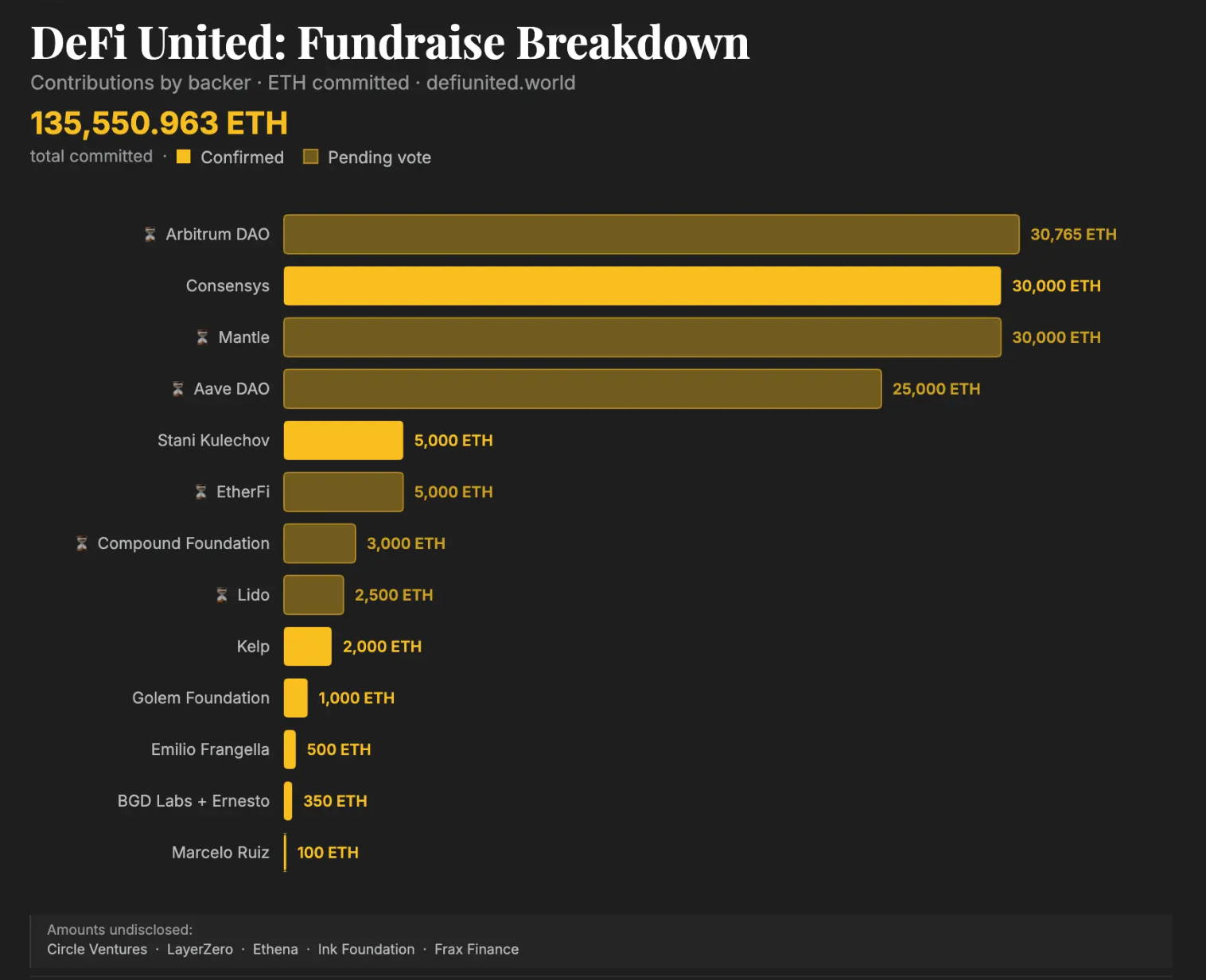
While Aave has so far committed 25,000 ETH, there is currently a governance proposal which if approved, would see its DAO able to contribute up to 250,000 ETH to the recovery effort. Aave’s founder Stani Kulechov has also pledged 5,000 ETH from his personal holdings, while others closely linked to Aave, including Emilio Frangella and Ernesto Boado, have pledged smaller amounts.
Related: Aave Hit by $15B Outflows as Kelp DAO Exploit Sparks DeFi Liquidity Shock
Recovery Effort Extends Across Ethereum Ecosystem
While Aave has played a key role in driving the DeFi United initiative, financial support has come from a large number of organisations and individuals across the Ethereum ecosystem.
Consensys, the company behind Metamask, has agreed to commit as much as 30,000 ETH to the effort, staking platform Lido has a governance proposal to set aside 2,500 of its stETH token, and EtherFi is considering a plan to contribute 5,000 ETH. The Ethereum Layer-2 network Mantle has a proposal to contribute up to 30,000 ETH to a credit facility, which would act as backstop liquidity for future DeFi incidents.
Other players in the space are contributing by depositing directly into Aave to support its lending pools. Liquid staking protocol Renzo has deposited more than US$10 million (AU$14m) from its treasury, while Babylon Foundation is considering a plan to deposit US$3 million (AU$4.1m) in USDT.
Advertisement
Circle Ventures has been purchasing AAVE tokens, posting on X that it’s doing so because “strong DeFi infrastructure does not build itself […] we’re backing that ecosystem and the entire community built around it.”
Some contributions have even come in from individuals and organisations outside the Ethereum ecosystem, including from Tron founder Justin Sun, the Solana Foundation and the Avalanche Foundation, according to Aave Labs.
Related: DeFi Hit by Exploit Shockwave as US$600M+ Losses Trigger Sharp Market Retreat
Aave Labs also has an active proposal requesting that Arbitrum’s Security Council release over 30,000 frozen ETH with the aim of “making affected rsETH holders whole” and bolstering rsETH’s backing.
Commenting on the cooperative effort to support the Ethereum DeFi ecosystem, Consensys founder Joseph Lubin said in a statement, “the Ethereum ecosystem has always been at its best when it moves together.”
DeFi United is exactly that, a broad, coordinated response to protect users and strengthen the infrastructure we’ve all helped build. Consensys is proud to contribute alongside other stewards in the ecosystem.
 Joseph Lubin, Consensys founder
Author
Jody McDonald
Jody is a Brisbane-based freelance writer who specialises in writing about business, technology, and the future of work.