Advertisement
BIS Finds Bitcoin Transfer Estimates Can Vary Sixfold Depending on Measurement Method
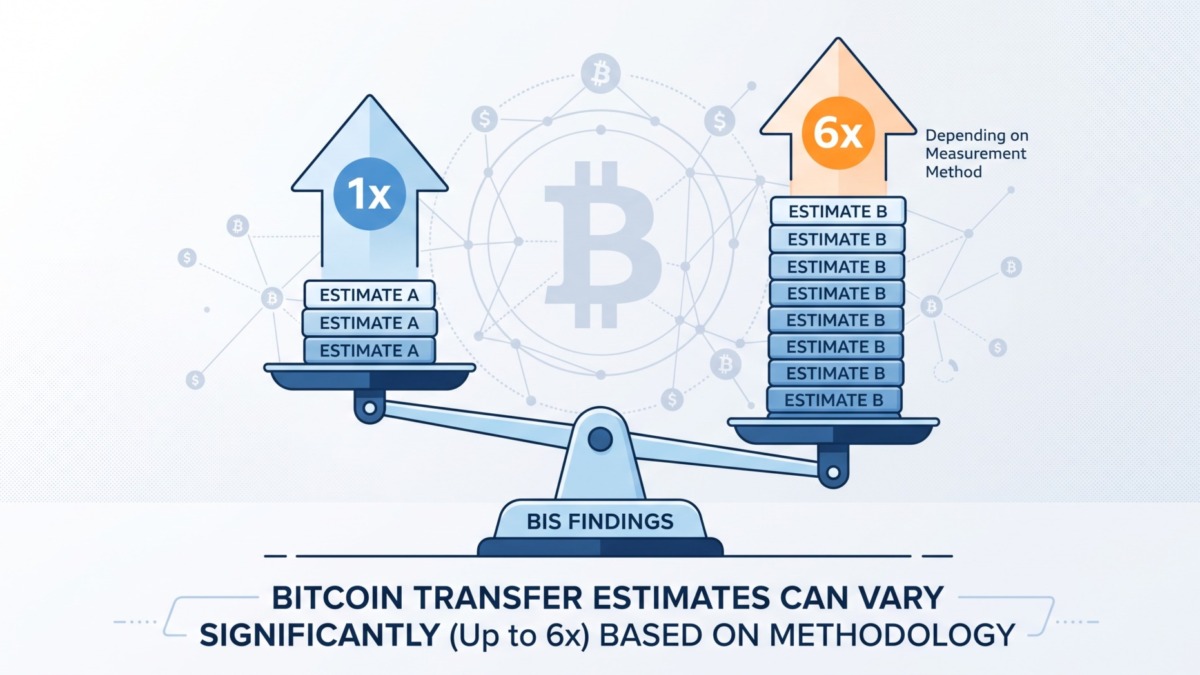
- New BIS research finds that estimates of Bitcoin’s onchain transfer value can vary by up to sixfold depending on the methodology used.
- The discrepancy arises because Bitcoin’s UTXO system generates “change” outputs that are difficult to distinguish from genuine payments to third parties.
- Researchers must rely on heuristics to identify change, and these assumptions can dramatically alter reported transfer volumes.
- The BIS concludes that onchain data should be treated as an approximate guide to economic activity rather than a precise measurement.
Estimates of how much Bitcoin is transferred onchain can differ enormously depending on how the transactions are measured, according to a new working paper from the Bank for International Settlements (BIS).
The paper, BIS Working Paper No. 1377, was authored by Timothy Aerts, Ronald Heijmans, Jan Paulick and Violeta Vuletic and published in September 2026.
It highlights the difficulty of using raw blockchain data to measure economic activity. The BIS researchers examined different methods for estimating onchain transfer values and found that the choice of methodology alone can swing the results dramatically – in some cases, the most conservative estimate came in at roughly a sixth of the most permissive one.
The issue stems in part from Bitcoin’s transaction structure. Bitcoin uses a system of unspent transaction outputs, or UTXOs, rather than account balances. When a user spends Bitcoin, the entire UTXO being used must be spent in the transaction. If the user spends less than the value of that UTXO, the remaining funds are typically sent back to the user as “change”.
For instance, imagine someone holds a single UTXO worth 4 BTC and wants to pay a merchant 1.5 BTC. The resulting transaction would need to generate two outputs: 1.5 BTC going to the merchant, and the leftover 2.5 BTC returning to the original owner as change. Looking only at the raw blockchain data, both outputs look identical – as far as the ledger is concerned, 4 BTC total just moved – even though only 1.5 BTC actually changed hands.
Read more: US Moves to Seize $61M in Crypto Linked to Sanctioned Iranian Oil Sales
Identifying which outputs represent change is therefore essential to estimating how much Bitcoin actually moves between different users. But the blockchain doesn’t label this distinction. Wallets can, for example, route change to a brand-new address, making it just as anonymous-looking as a genuine payment to a third party.
No Accurate Measure of Economic Activity
As a result, researchers have to lean on heuristics and assumptions to guess which outputs are changed. The BIS paper shows just how much this guesswork matters: depending on which heuristic is applied, estimates of onchain transfer volume can differ by a factor of roughly six.
The researchers frame this as symptomatic of a broader problem in analysing crypto activity. Onchain data is transparent and abundant, but that doesn’t make it self-interpreting. Figures drawn from it carry real uncertainty and shouldn’t be mistaken for a precise readout of genuine economic activity.
Notably, the findings don’t relate to Bitcoin trading volumes on centralised exchanges. They’re specifically about how much value is estimated to move directly on the blockchain itself – underscoring how much the interpretation of raw chain data can shape conclusions about network activity.
Advertisement
Read also: Bitmine’s $15.4B Ether Treasury Could Generate $334M in Annual Staking Revenue

Author
Aaron Feuerstein
Aaron Feuerstein is a freelance writer based in Melbourne. His focus is on decentralised finance and the regulatory space surrounding blockchain. He holds a Master's in Accounting. When he is not studying the latest legal case, he enjoys his time as a modest but eager hobby cook.