Advertisement
Strategy And Metaplanet Removed from MSCI Indexes, Risking Billions in Passive Fund Outflows
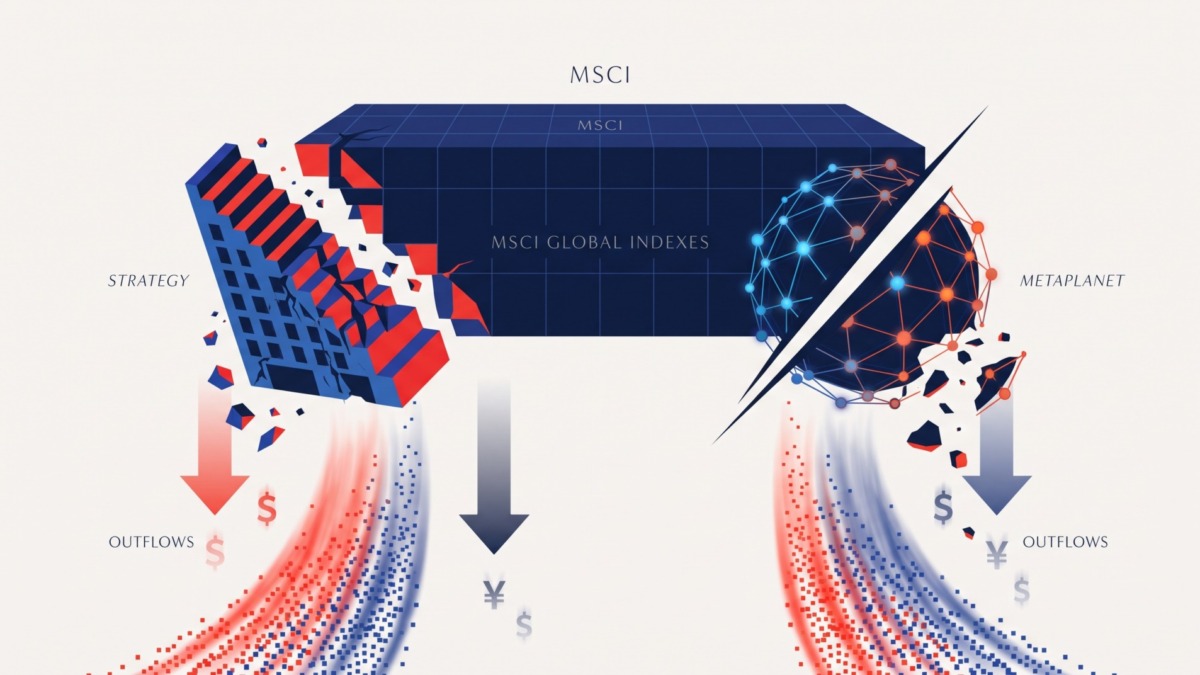
- MSCI will remove Strategy from its Global Standard Indexes and Metaplanet from its Global Small Cap Indexes under new rules targeting companies with substantial non-operating assets.
- Estimates say Strategy could face US$2.8 billion in passive outflows, potentially rising to US$8.8 billion if other index providers follow suit.
- The removals could weaken demand for Strategy shares and complicate future Bitcoin purchases, although the company would not be required to sell its BTC holdings.
- The changes take effect on 1 December, with Strategy shares falling 2.6% in after-hours trading following the announcement.
And it’s final. MSCI has announced it is moving ahead with the removal of Michael Saylor’s Strategy and Japanese firm Metaplanet from its indices. Both have taken the path of Bitcoin treasury firms, which has resulted in their classification as non-operating companies under MSCI’s new rules.
Strategy is being removed from the MSCI Global Standard Indexes, whereas Metaplanet is leaving the MSCI Global Small Cap Indexes.
As we reported back in October, MSCI was moving towards a rule change which broadens its scrutiny beyond crypto treasury firms to companies holding substantial non-operating assets.
Companies with more than 50% operating assets pass the initial screen, while those below that threshold face further assessment of operating activity, cash flow, asset-value fluctuations and reliance on external funding. Companies that fail four of the five financial tests are deemed ineligible, with existing constituents required to fail the screening in both of their two most recent annual reporting periods before removal.
Read also: Binance Hackers Create Elon Musk and Animal Memecoins to Move Stolen Crypto
Strategy has previously criticised MSCI’s approach as “discriminatory”, arguing that excluding digital asset treasury companies would undermine the index provider’s neutrality. The company also maintained that its removal would have no meaningful impact on its business.
Billions Estimated to Leave Strategy
It’s estimated that up to US$2.8 billion (AU$4.09 billion) in Strategy shares could potentially be sold by index-tracking funds. JPMorgan even put that number as high as US$8.8 billion (AU$12.8 billion) if other index providers go down the same path.
The removal could force passive funds tracking the affected indices to sell their holdings, potentially reducing demand for Strategy shares. While this does not require Strategy to sell any of its Bitcoin, weaker demand for its shares could make it more difficult for the company to raise capital to fund future Bitcoin purchases.
The rule change will take effect after trading closes on 30 November, with the index changes effective from 1 December. Strategy’s share price fell 2.6% in after-hours trading following the announcement, while Metaplanet had closed down 2.53% earlier in the day, before the decision was announced.
Read also: Bitcoin Miners HIVE and MARA Produce More BTC but Earn Less as Revenue Falls
Advertisement

Author
Aaron Feuerstein
Aaron Feuerstein is a freelance writer based in Melbourne. His focus is on decentralised finance and the regulatory space surrounding blockchain. He holds a Master's in Accounting. When he is not studying the latest legal case, he enjoys his time as a modest but eager hobby cook.