Advertisement
BlackRock’s IBIT Nears Record Outflow Streak as Bitcoin ETFs Shed US$1.43 Billion
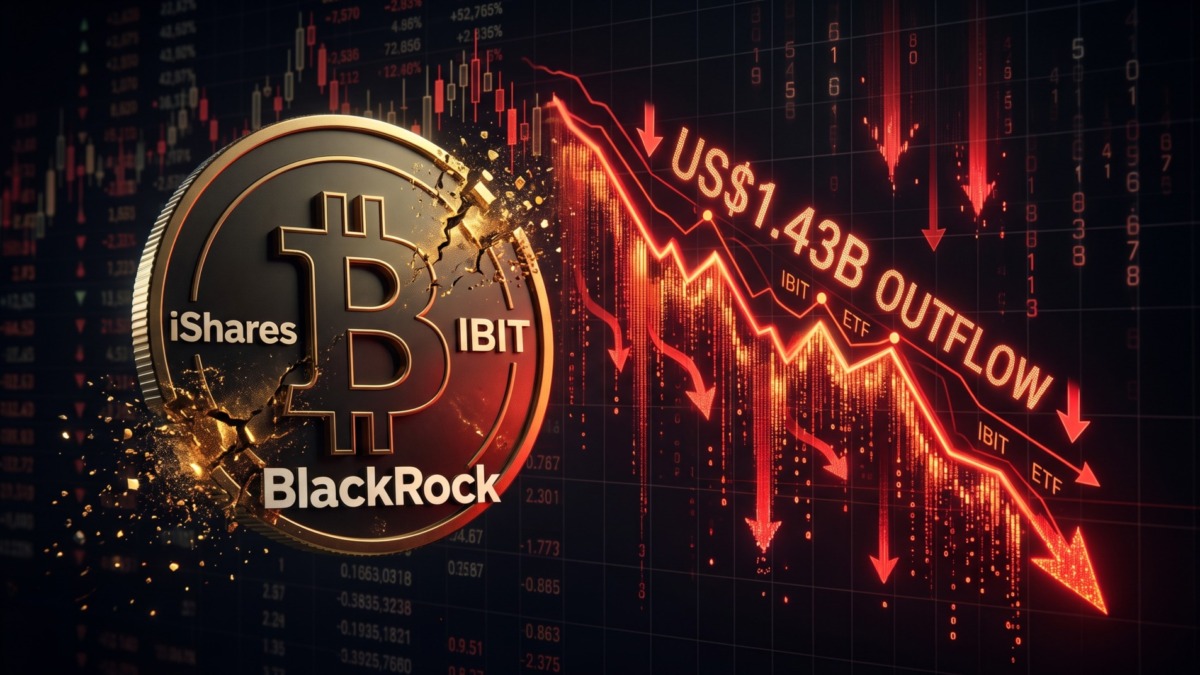
- US spot Bitcoin ETFs extended their net outflow streak to five trading days, with US$1.43 billion withdrawn, compared with a record 13-day streak totalling US$4.4 billion.
- BlackRock’s IBIT recorded nine consecutive days of net outflows totalling US$2 billion, approaching its previous 11-day losing streak.
- Bitcoin dropped 8.59% over the week to US$73,455, while Ethereum, XRP and Solana suffered even steeper weekly declines.
- Economists expect the Federal Reserve to raise interest rates by 25 basis points in December, potentially adding further pressure to Bitcoin and other risk assets.
US spot Bitcoin ETFs continue to record net outflows. It’s now the fifth consecutive day of outflows, which have reached US$1.43 billion (AU$2.09 billion). For comparison, the longest-ever outflow streak lasted 13 trading days from 15 May to 3 June, when US$4.4 billion (AU$6.4 billion) in net outflows occurred.
BlackRock’s IBIT, though, is on a more worrisome trajectory. IBIT has now seen nine days of net outflows, with a total of US$2 billion (AU$2.9 billion) leaving the fund over that period. That was surpassed only by an 11-day streak from 17 June to 2 July, when IBIT saw US$2.2 billion (AU$3.2 billion) in net outflows.
Bitcoin itself was also down 0.3% over the past 24 hours and 8.59% over the past week. At the time of writing, it traded at US$73,455 (AU$107,415).
Ethereum slid by 1% on the day and 15.7% over the week, sitting at US$2,039 (AU$2,981), while XRP was down 1.5% and 20.5%, respectively, with a current price of US$1.03 (AU$1.50).
Solana was also down 0.2% and 13.7% over the same time frames, selling for US$82.66 (AU$120.88) at press time.
Related: Bitcoin Falls Below US$74K After Hot US Inflation Data, With US$70K in Sight
The Broader Economic Outlook
US equities rebounded on Wednesday, led by technology stocks. The S&P 500 gained 1.31%, the Nasdaq Composite rose 1.60% and the Dow advanced 0.49%. However, the recovery showed signs of weakening in subsequent futures trading, with S&P 500 and Nasdaq futures turning negative.
And then there’s inflation. A Reuters poll has revealed that most economists haven’t changed their views on the topic since the US midterms.
Economists expect a 25-basis-point hike to 4.00%–4.25% in December. The Fed left rates unchanged in October after the September hike.
Read also: Moody’s and Chainlink Test Cross-Chain Credit Ratings
Advertisement
The prospect of further rate hikes could add pressure to risk assets such as Bitcoin, as higher borrowing costs and tighter financial conditions make speculative investments less attractive.
Tom Porcelli, chief economist at Wells Fargo, said that the “Fed is at the mercy of incoming inflation data and it will lend itself to the Fed raising rates once more”.
There was a fair argument that the Fed could have easily raised rates at this October meeting.
 Tom Porcelli, chief economist at Wells Fargo

Author
Aaron Feuerstein
Aaron Feuerstein is a freelance writer based in Melbourne. His focus is on decentralised finance and the regulatory space surrounding blockchain. He holds a Master's in Accounting. When he is not studying the latest legal case, he enjoys his time as a modest but eager hobby cook.