Advertisement
Bitcoin’s “Silent IPO” Moment: Why Sideways Trading Could Signal Bigger Things Ahead

- Bitwise CIO, Matt Hougan, believes Bitcoin’s recent sluggish price action is reflective of it currently undergoing a “silent IPO” in which early investors sell and institutional buyers enter the market.
- Hougan argued that Bitcoin is behaving similarly to how tech stocks such as Facebook and Google did following their IPOs, suggesting it’s likely Bitcoin will see strong growth following a period of sideways price action.
- Hougan also thinks institutions are likely to start making larger Bitcoin allocations as its volatility continues to decline.
Bitcoin’s recent sluggish price action doesn’t signal the end of the road for the OG cryptocurrency, but instead reflects its transition from “crazy idea to mainstream success,” according to Matt Hougan, CIO at asset manager Bitwise.
Building on ideas from a piece written by fellow crypto analyst and President of Weiss Multi-Strategy Advisers, Jordi Visser, Hougan wrote in a recent blog that Bitcoin is currently undergoing a “silent IPO.” He believes Bitcoin is behaving similarly to other tech IPOs, including Facebook and Google, both of which also experienced sideways price action after they went public, as early investors took profits and institutional investors stepped in.
The process of insiders selling and institutions buying takes time. Only after that transition has hit a certain balance can the stock resume its upward march.
 Matt Hougan, Bitwise CIO
 Hougan gives the example of Facebook, which went public in 2012 at a price of US$38 per share. For the next 15 months, Facebook’s share price didn’t break above US$38 (AU$58) as early investors took profits, keeping the price down. Now though, Facebook is trading at US$637 (AU$981), an increase of 1576%.
Hougan believes a similar re-distribution of Bitcoin is currently occurring.
“Early believers who bought bitcoin when it was $1, $10, $100, or even $1,000 are sitting on generational wealth. Now that bitcoin has graduated to the big leagues—with ETFs trading on the NYSE, major corporations building reserves, and sovereign wealth funds buying in—these investors can now harvest their rewards,” he said.
However, Hougan does hedge his bets slightly. He admits that onchain data “paints a mixed picture of who’s selling,” although he maintains that the re-allocation from early investors to institutional investors is an important part of what’s going on.
Related: Bitcoin Slips Below $105k as Analysts Warn of Further Downside — and a Whale Buys the Dip
Bitcoin Re-allocation Is “Extremely Bullish” Says Hougan
Hougan believes the exit of early investors and entry of institutional investors is a bullish sign, suggesting Bitcoin’s future could mirror Facebook’s post-IPO performance — a prolonged period of sideways movement followed by sustained growth.
Going forward, we’re unlikely to see 100x returns in a single year. But there is still massive upside once the distribution phase is complete.
Matt Hougan, Bitwise CIO Hougan added that Bitwise believes “bitcoin will reach $1.3 million by 2035.” He noted that his personal view is that this price prediction is conservative.
The Bitwise CIO also argued that, unlike a regular company that requires constant growth and new sources of revenue to sustain share price increases, Bitcoin doesn’t need any of that.
Advertisement
“Once the OGs are done selling, bitcoin doesn’t need anything. The only thing necessary for bitcoin to go from a $2.5 trillion market cap to $25 trillion—gold’s size—is broad acceptance,” Hougan wrote.
“If you take the long view, bitcoin chopping sideways is a gift. I see it as an opportunity to buy more bitcoin before it resumes its ascent.”
Bitcoin’s Reduced Volatility Is Making It a Safer Investment
Hougan also highlighted Bitcoin’s long-term trend of becoming less volatile, suggesting this lower volatility makes it a safer investment and therefore large institutional investors are likely to make larger allocations.
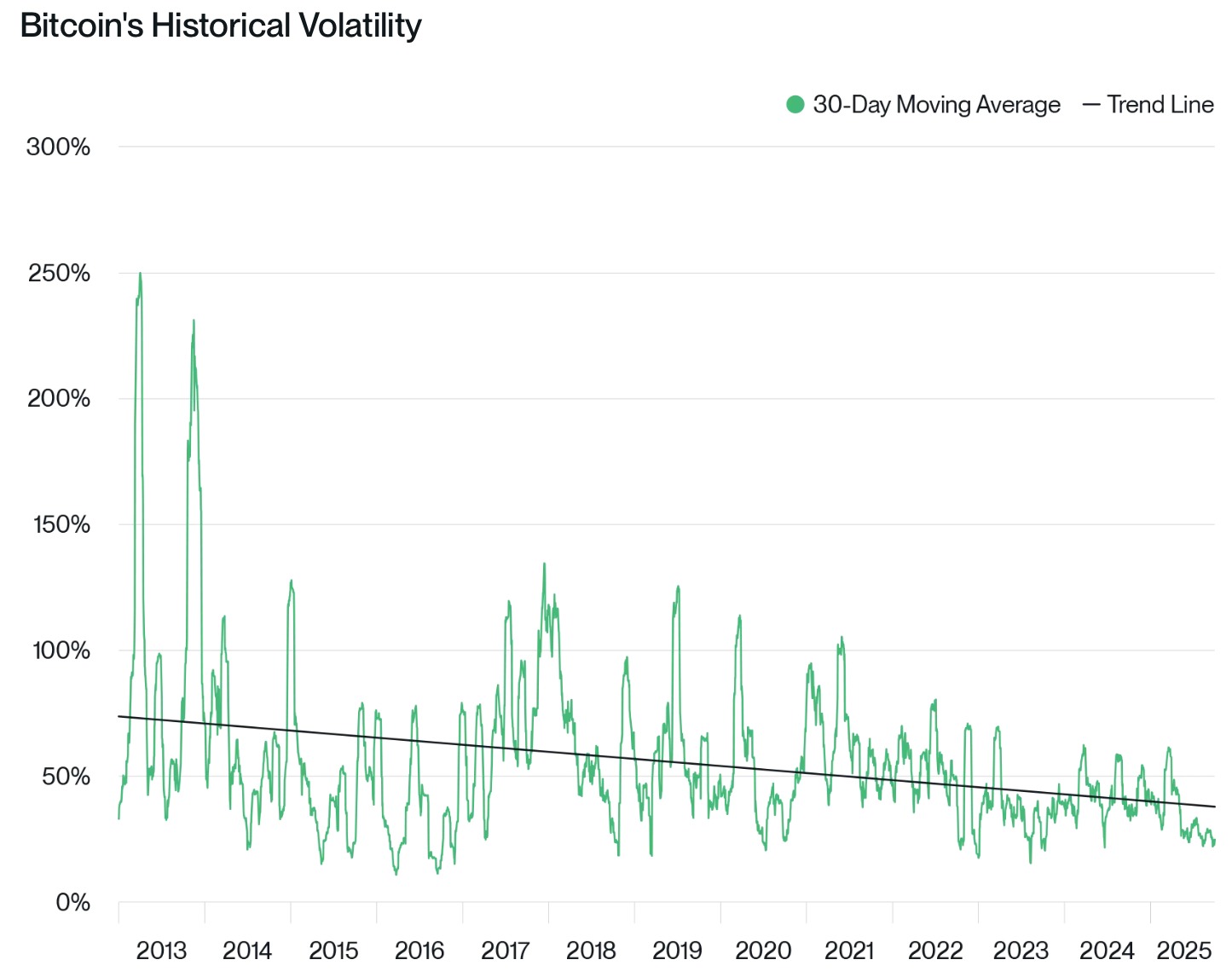
In the future, bitcoin is likely to have somewhat lower returns and significantly lower volatility than in the past.
Matt Hougan, Bitwise CIO “As an allocator, my response to this dynamic would not be to sell the asset—after all, we forecast bitcoin to be the best-performing large asset in the world over the next decade—but rather, to buy more of it. Put differently, lower volatility means it’s safer to own more of something.”
Hougan said larger institutional Bitcoin allocations are very much on the cards as Bitcoin moves out of its highly volatile early era and transitions to a period of behaving more like a traditional tech stock.
“The days of a 1% allocation to bitcoin are over. Increasingly, investors need to be thinking of 5% as a starting point.”

Author
Jody McDonald
Jody is a Brisbane-based freelance writer who specialises in writing about business, technology, and the future of work.