


Advertisement
What is Liquid Staking? Top Liquid Staking Protocols in 2026

Liquid staking sounds a bit complex at first, but think about it this way: Liquid staking is staking without the ‘cool, now I can’t touch my funds for days’ part.
That’s because you stake your tokens, get a token (LST) back as a receipt, and that receipt stays usable while your staking rewards keep stacking in the background. So instead of choosing between earning yield and having flexibility, you get a setup that’s closer to ‘Well, now I can earn yield, stay liquid, and keep a few options open.’
The corresponding liquid staking token can be held, traded, or used in DeFi while the underlying stake continues generating rewards, turning staking from a static commitment into something you can actively manage.
This guide explains liquid staking in plain terms, presenting the options available to DeFi users. Then we go protocol-by-protocol across major blockchain ecosystems, showing how the big names differentiate in features (higher yield designs, deeper liquidity, MEV boosts, decentralization choices, and fast exits) to help you make an informed choice.
Let’s get to it.
Lido Finance
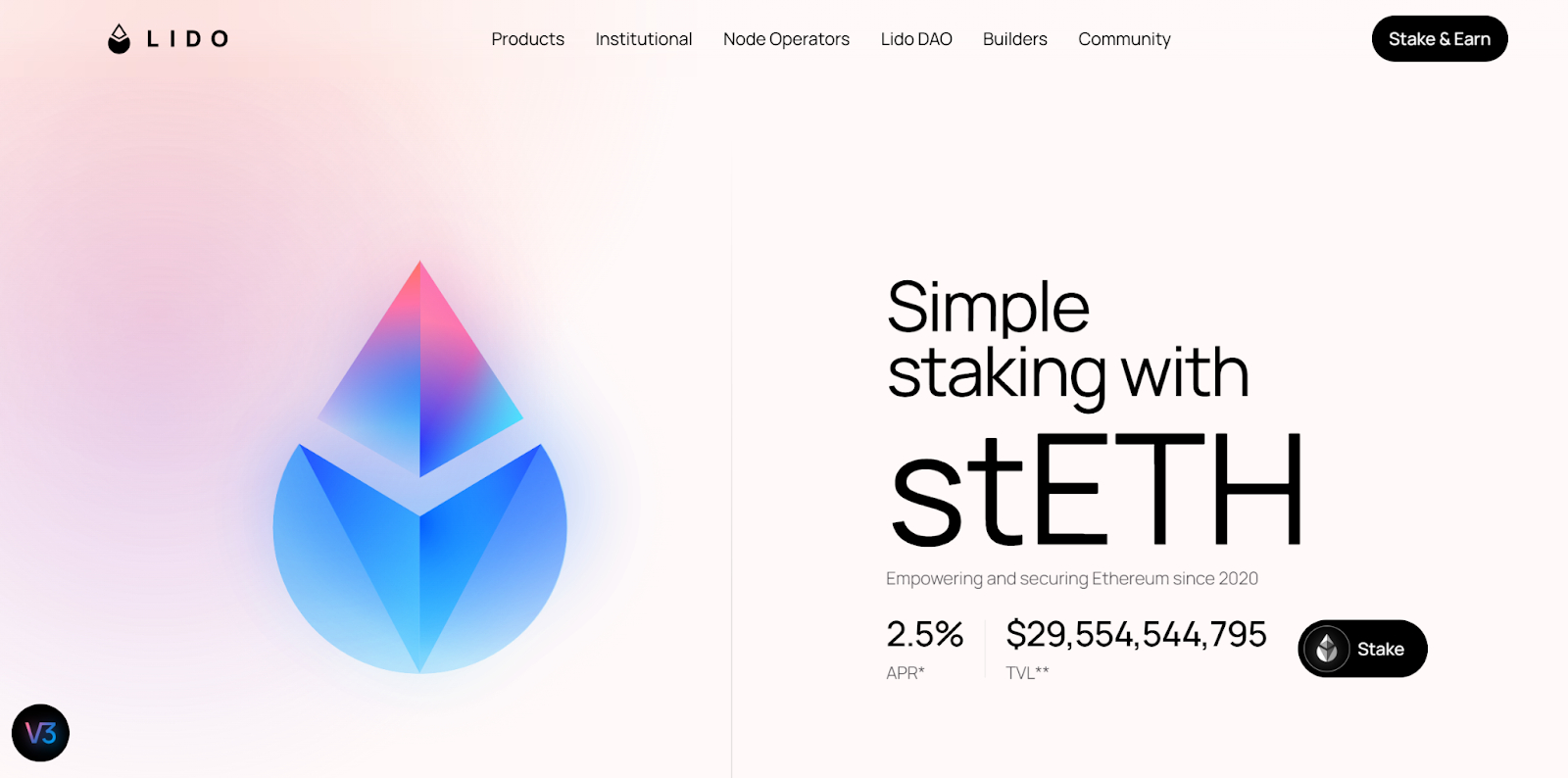
Lido Finance (or Lido.fi) has been, for many years now, the biggest liquid staking option on Ethereum (ETH).
When using Lido, like most other platforms, you stake ETH to earn staking rewards. But instead of your ETH being locked in a smart contract and unusable, you receive a token that represents your staked position. With Lido, that token is stETH.
This token is widely integrated across DeFi, which matters because the more places a receipt token can be used, the more useful it becomes. You can use stEth for various activities – such as providing collateral for lending, participating in liquidity and pools and so on.
Lido staking requires ‘no minimum’ stake, which means anyone can stake even tiny amounts and still get a liquid token back.
The yield number is what stakers earn over time from Ethereum staking, and Lido takes a percentage of the rewards as a protocol fee. You should always check Lido’s official website in order to check the latest APR, which is constantly changing alongside market conditions.
Advertisement
Jito Network (JitoSOL)
Jito is Solana’s biggest liquid staking platform.
One thing that makes Jito different is the protocol adds MEV-based rewards on top of standard staking.
MEV (Maximum Extractable Value) is essentially the profit captured by reordering transactions, often by paying a premium to ‘skip the line’. In many systems, MEV can be harmful to regular users if it’s extracted unfairly, with these extra rewards concentrated in high-value network operators. Jito’s pitch is to optimise MEV in a way that shares the benefit back to stakers rather than concentrating it with a small set of operators.
The yield numbers can vary based on product choice. A standard liquid staking product can come with a stated APY (as of January 2026, 5.95%), while there are also higher-yield options ‘for certain pools’ if MEV optimisation is more aggressive or if the pool mechanics differ.
For beginners, the key takeaway is that MEV-enhanced yield is more variable than base staking because it depends on network conditions, demand for blockspace, and how MEV is being captured and distributed.
Key features of Jito
- APY: At the time of writing, 5.77% for the standard product; ‘up to 15%’ for certain MEV-optimized pools (as stated)
- MEV rewards for an extra return stream that can increase yield but also increases variability
- Multiple staking tiers, DeFi-friendly integrations, JPoints gamification layer
Rocket Pool

Rocket Pool is a more permissionless staking model, designed to be more decentralised by letting anyone run a node without needing approval.
It also lowers the ETH needed to become a node operator from 32 ETH (solo staking) to 8 ETH. The missing ETH is pooled from other users (delegators) who want to stake but don’t want to operate infrastructure.
Therefore Rocket Pool allows more people to participate in the validator side of staking – not just as passive depositors – which theoretically spreads control across more operators and assists in decentralisation of the network.
Like other liquid staking platforms, Rocket Pool provides a native LST, known as rETH.
Rocket Pool provides an average APR of about 2.2% to 2.8%, depending on market conditions. You can unstake at any time without minimum lock up periods, and also use the rETH token on DeFi apps across Ethereum.
Marinade Finance (mSOL)

Marinade is another liquid staking giant on Solana and one of the most established by user base. The platform’s native LST is mSOL, with functions across much of the Solana ecosystem.
The central mechanism here is delegation across many validators (100+), guided by an ‘algorithmic rebalancer’, which, in simple words, tries to balance two goals: higher yield and stronger decentralisation.
The practical use case here is that your stake is not concentrated in one validator; it’s spread out, which can reduce reliance on a small set of operators.
Marinade is framed as using an architecture intended to reduce the amount of custom smart-contract exposure compared with some alternatives, while still offering liquidity features like instant exit (usually for a fee that changes with market conditions).
Key features of Marinade:
- APY: 6.21% liquid staking (as of January 2026); over 10% for native staking.
- Over 148K holders.
- Fees vary, but usually 6% of staking rewards.
- Delegation across 100+ validators, alongside transparent ranking of validators and rebalancing.
- Instant unstaking with variable fees, deep DeFi integration via mSOL.
BENQI Liquid Staking (sAVAX)

BENQI is Avalanche’s first major liquid staking protocol and a core part of its DeFi stack. The basic mechanic is standard – stake AVAX, receive sAVAX, with sAVAX representing your staked position plus ongoing rewards.
Interestingly though, BENQI does not have any slashing penalties, in-line with Avalanche’s staking model. Unlike Ethereum, the penalty risk for bad behaviour among stakers is framed more around opportunity cost (e.g., not earning rewards if you fail conditions) rather than losing principal through slashing, depending on Avalanche’s rules.
Key features of BENQI
- APY: Network staking 6 to 9%; BENQI competitive rates adjusted for fees.
- Minimum delegation: 25 AVAX (delegators); 2,000 AVAX (validators)
- Unstaking period: Minimum 14 days (network requirement)
- DeFi usability of sAVAX (lending, LP, collateral), auto-compounding, no slashing penalties on Avalanche (as stated).
Lista DAO
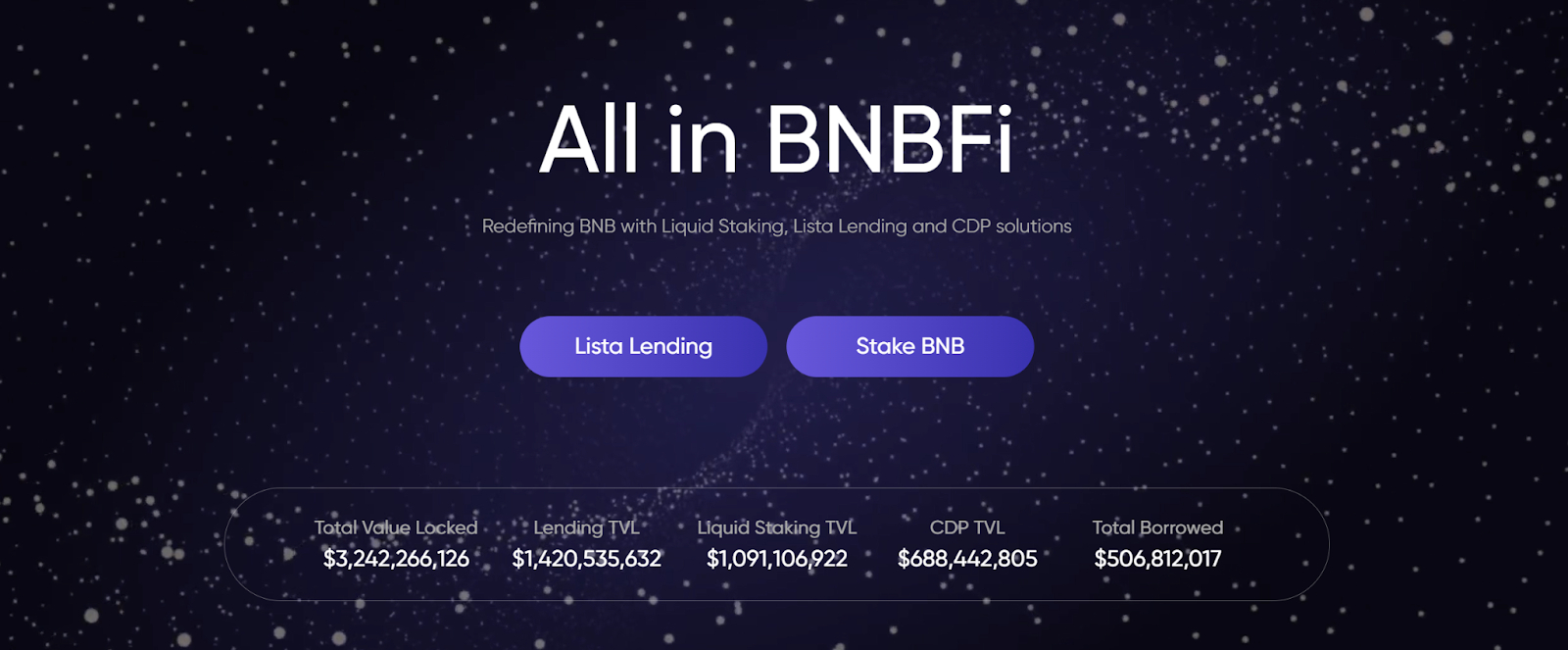
Lista is positioned as the leading BNB liquid staking protocol, running through a self-managed validator (Synclub). The protocol keeps a small portion of validator rewards and reflects the rest to users through slisBNB value appreciation, meaning slisBNB gradually becomes redeemable for more BNB over time.
There’s a particular feature that Lista offers: CDP functionality, which uses slisBNB as collateral to mint a stablecoin (lisUSD) while still earning staking rewards. That lets you keep staking yield while borrowing against your position.
Key features of Lista DAO:
- APY network base yields between 5–7% for BNB staking.
- Fees are usually 5% of validator rewards retained.
- Usable across BNB Chain and Ethereum, broad DeFi integrations (Tranchess, Karak, PancakeSwap, Thena), avoids 7-day unbonding delay, CDP collateral to mint lisUSD.
Pros and Cons of Liquid Staking: The Advantages and Risks to Consider
Liquid staking solves the main drawback of traditional staking: lockups. Instead of staking and losing access to your asset until an unbonding period ends, you stake and receive a liquid staking token (LST) that represents your position. You keep earning staking rewards, but you also hold something you can move, trade, or use in DeFi.
Advantages of Liquid Staking
Because the LST is liquid, you can react to markets, move funds, or exit quickly by selling the token or using instant redemption features where they exist. This reduces the ‘stuck capital’ problem of normal staking. In short:
- Faster exits and reallocations.
- Less missed opportunity when new trades or yields appear.
LSTs can be used across DeFi while the underlying stake keeps earning. That makes strategies like borrowing against the LST, providing liquidity, farming incentives, or restaking possible, which translates into:
- More ways to deploy the same capital.
- Potential to stack returns (with more risk).
Liquid staking removes barriers like high minimums and validator operation complexity. Small holders can participate without running infrastructure. No validator setup required, and it often works with small deposits.
Disadvantages and Risks of Liquid Staking
Liquid staking adds a protocol layer and a market-traded token, which introduces risks beyond native staking: smart contract failure, LST price drifting from the underlying asset, and liquidity or governance issues. So it is extra protocol and market risks on top of chain risk.
Specifically, smart contract risk is the chance the protocol is exploited or fails, while de-peg and liquidity risk is the chance the LST trades at a discount when you need to exit, which can also trigger liquidations if used as collateral.
Moreover, centralisation and validator risks come from operator concentration, governance changes, and validator penalties on networks that slash. Complexity and fees reduce net yield and increase the chance of mistakes.
So, to narrow down the risk factors you need to keep in mind:
- Contract failure/exploit.
- Depeg/slippage and liquidation cascades.
- Governance/operator concentration and validator penalties (network-dependent).
- More complexity + fee drag.
Liquid Staking or Traditional Staking?
It’s a good question, and one that comes down to personal preference between flexibility but higher risks, and rigidity but lower risks. Liquid staking gives you a tradable token representing your stake, so you keep liquidity and can use it in DeFi, but you take on extra protocol and market risks.
Liquid staking is usually the way to go if you care about being able to exit or redeploy quickly, or if you want to use staked value in DeFi while still earning staking rewards. In short:
- Liquidity: you can sell or redeem instead of waiting unbonding.
- Capital efficiency: use LSTs as collateral, in pools, farms, or restaking.
On the other hand, traditional staking is better (or more ideal) if you want the simplest setup and the cleanest risk profile. You are less exposed to smart contract and depeg/liquidity risks that come from LST protocols and markets. In short:
- Lower complexity and fewer extra risk layers.
- Often higher ‘base’ yield if you’re passive, since there’s no protocol fee layer.
Yield: Depends on Behavior
Traditional staking usually wins for passive users. Liquid staking can win if you actively deploy the LST in DeFi to add extra return, accepting extra risk.
So, which one? If you want simplicity and lower protocol risk, choose traditional staking. If you want liquidity and DeFi utility, choose liquid staking.
Closing Thoughts on Liquid Staking and the Top Staking Protocols
Liquid staking is one of those many markets in crypto that sounds extremely complex (it is, to an extent) but it can be more flexible than traditional staking and is often less intimidating than it appears. This is because it turns a position into a usable asset, and the best protocols make that liquidity genuinely productive.
On Solana, options like Marinade and Jito show how LST design can add fee revenue, validator diversification, or MEV capture on top of base staking. On Ethereum, deep-liquidity standards like stETH sit alongside decentralisation-first designs like rETH and strategy-driven products like OETH, giving users different paths to stake and still stay active.

Author
José Oramas
José is a journalist and translator with a keen interest in blockchain and cryptocurrencies.