


Advertisement
Top 10 Crypto Collateral Loan Services in Australia
Please note that Crypto News Australia is a subsidiary of Swyftx, and this article features Swyftx products or services.

Want cash without selling your crypto? That’s the whole idea behind a crypto collateral loan. You hand over your Bitcoin as security, the lender gives you money, and you get the crypto back when you repay the loan. You get to retain exposure to the crypto market’s movements the entire time, while gaining access to liquid funds.
Crypto-backed loans tend to work differently to other loans you may be familiar with though. There’s usually no credit check, funding can land the same day, and your loan to value ratio, or LVR, is key. Considering that the digital asset market is traditionally more volatile than other financial sectors, these loans often require overcollateralisation to mitigate swings in security value. This means if you borrow too much against your Bitcoin, a significant fall in the price can force a partial, or even full, liquidation of your collateral.
Below are ten services available to Australians in 2026. Australian providers come first, then global and decentralised platforms.
Australian providers compared
| Provider | Funded in | Security accepted | Max LVR | Interest rate |
| Swyftx | AUD | Bitcoin | Up to 40% | 9.50%, 11.93% comparison |
| Independent Reserve | AUD | Bitcoin, Ethereum, XRP | 40% line of credit, 50% fixed | Not published |
| Vield | AUD | Bitcoin | 50% | 13% APR, 16.20% comparison |
| Matias Group | Not published | Not published | Not published | Not published |
| Ledn | USD | Bitcoin, USDC | 50%, margin call 70% | 7.99% to 9.49% |
| Nebeus | EUR or USDC | 15+ assets | 65% to 70% | 4% to 12.5% |
| Binance | Crypto only | Wide range | 65%, liquidation 83% | Variable, updates hourly |
How we assessed these providers
Every provider was checked against the same criteria, using only what each one publishes itself. That means AUSTRAC registration and any Australian credit licence, whether loans are funded in Australian dollars, what’s accepted as security, the published interest and comparison rates, the maximum LVR and the point a margin call lands, and who ends up holding your crypto.
Where a provider doesn’t publish a figure, this guide says so rather than guessing at it.
Disclosure: Crypto News Australia and Swyftx are part of the same corporate group. That hasn’t affected how Swyftx was assessed or where it sits in this guide.
Australian providers
1. Swyftx
Swyftx is an Australian-owned exchange that launched in 2018, adding crypto-backed loans to its list of features in 2026. The product allows you to borrow Australian dollars against your Bitcoin without selling it, with the money typically landing in an Australian bank account within 24 hours of the security being locked up.
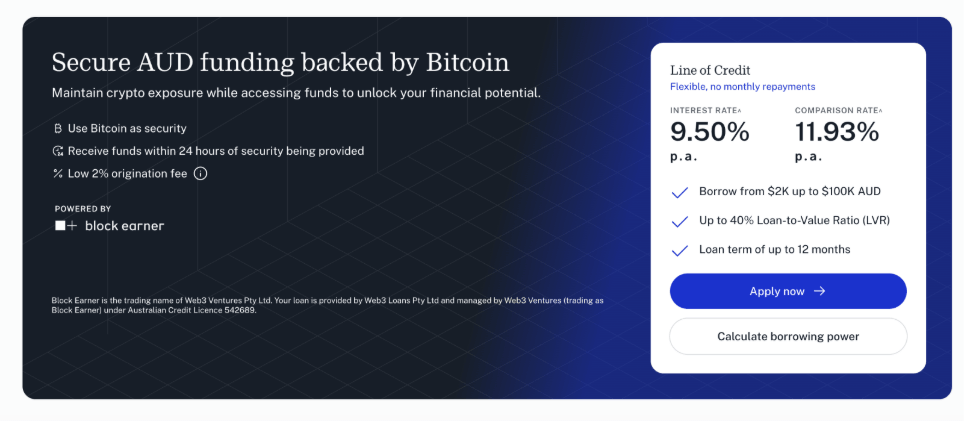
Loans run from $2,000 to $100,000 AUD depending on the value of your security and lender approval, and the Swyftx crypto-backed loans page publishes what you can borrow. Bitcoin is the only accepted security at the time of writing. Repayments are flexible, as there’s no monthly minimum and no early repayment fee, and you can top up your security whenever you want to improve the health of the loan.
There are limits on what the money can be used for. Examples of accepted reasons include non-financial investments, home improvement, holidays, a car, gifts. You generally can’t use it to buy crypto, shares or other financial products – so it’s worth double-checking if your borrowing aims are suitable for this product before diving in. Swyftx crypto-backed loans are open to personal accounts with an Australian bank account.
Advertisement
| Regulatory status | Swyftx Pty Ltd (ABN 72 623 556 730, AFSL 568543), AUSTRAC-registered |
| Security accepted | Bitcoin |
| Loan amounts | $2,000 to $100,000 AUD |
| Interest rate | 9.50% p.a., 11.93% p.a. comparison rate |
| Origination fee | 2% |
| Maximum LVR | Up to 40% |
| Funding time | Within 24 hours of security being provided |
| Early repayment fee | None |
| Custody | Not published |
2. Independent Reserve
Independent Reserve has been running since 2013 and now lends Australian dollars against crypto. It accepts Bitcoin, Ethereum and XRP as security, supporting loans anywhere from $50 to $5 million AUD.

You pick your structure. A line of credit with this feature runs 12 months with no mandatory monthly repayments – as long as it is paid off by the end of the loan’s lifetime. A fixed-term loan runs three to five years and does require them.
It’s worth noting that Independent Reserve publishes its full LVR health table, which not many lenders do. Bitcoin and Ethereum loans count as healthy between 40 and 50% LVR, tip into a repayment notice between 55 and 59.9%, and hit default risk above 60%, where you get 30 days to fix it. XRP is treated more conservatively and reaches default risk above 50%.
| Regulatory status | AUSTRAC-registered |
| Security accepted | Bitcoin, Ethereum, XRP |
| Loan amounts | $50 to $5,000,000 AUD |
| Interest rate | Not published |
| Maximum LVR | 40% line of credit, 50% fixed term |
| Funding time | Typically within 24 hours |
| Early repayment fee | Not published |
| Custody | Fireblocks |
3. Vield
Unlike the first two entries on this list, Vield was built around Bitcoin-backed loans from the start, rather than being an exchange that added lending later. It also publishes its terms in detail, which makes it easy to work out what a loan might actually cost you before you apply.
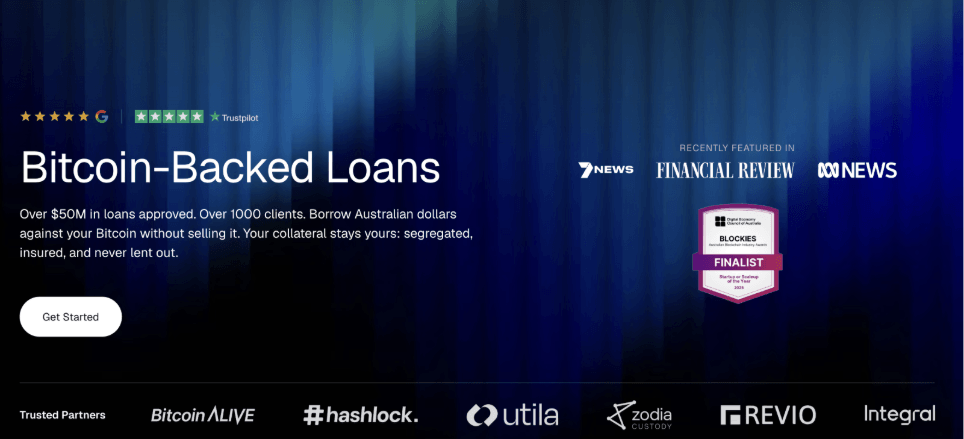
Loans run from $2,000 to $500,000 AUD over a fixed 12-month term, capped at 50% LVR. Interest is 13% APR compounded daily, with a comparison rate of 16.20% p.a. on a $5,000 loan, and a 2% origination fee on the amount you borrow. Those numbers put it at the higher end of the Australian options here, and the fixed term gives you less room to move than an open line of credit.
Your Bitcoin sits with Zodia Custody in cold storage using multi-signature wallets, insured up to US$55 million per incident. Vield states the assets are never lent, staked or reused, which is a valuable benefit of the product if honoured.
| Regulatory status | AUSTRAC VASP DCE100809730-001, credit arranged under Australian Credit Licence 526970 |
| Security accepted | Bitcoin |
| Loan amounts | $2,000 to $500,000 AUD |
| Interest rate | 13% APR, 16.20% comparison rate |
| Maximum LVR | 50% |
| Loan term | 12 months |
| Early repayment fee | Not published |
| Custody | Zodia Custody, insured to US$55M |
4. Matias Group
Matias Group offers crypto-backed lending to Australians and says approval and funding happen inside 24 hours. Beyond that there isn’t a heap of information available on the landing page. It publishes no interest rate, no LVR, no list of accepted security and no licence or registration number on its public platform, so you can’t compare it against anything else here without applying first.

| Regulatory status | No Australian Credit Licence, AFSL or AUSTRAC number published |
| Security accepted | Not published |
| Loan amounts | Not published |
| Interest rate | Not published |
| Maximum LVR | Not published |
| Funding time | Stated as within 24 hours |
| Early repayment fee | Not published |
| Custody | Not published |
Global options
Everything below either lends in a foreign currency or isn’t a lender at all. Read the custody and liquidation rows carefully, because that’s where these differ most from the Australian options.
5. Ledn
Ledn lends against Bitcoin globally and accepts Australian customers. However, there are several caveats with this model for Aussies – it lends in US dollars, not Australian ones, and it holds no Australian licence, which puts you outside local consumer credit protection.
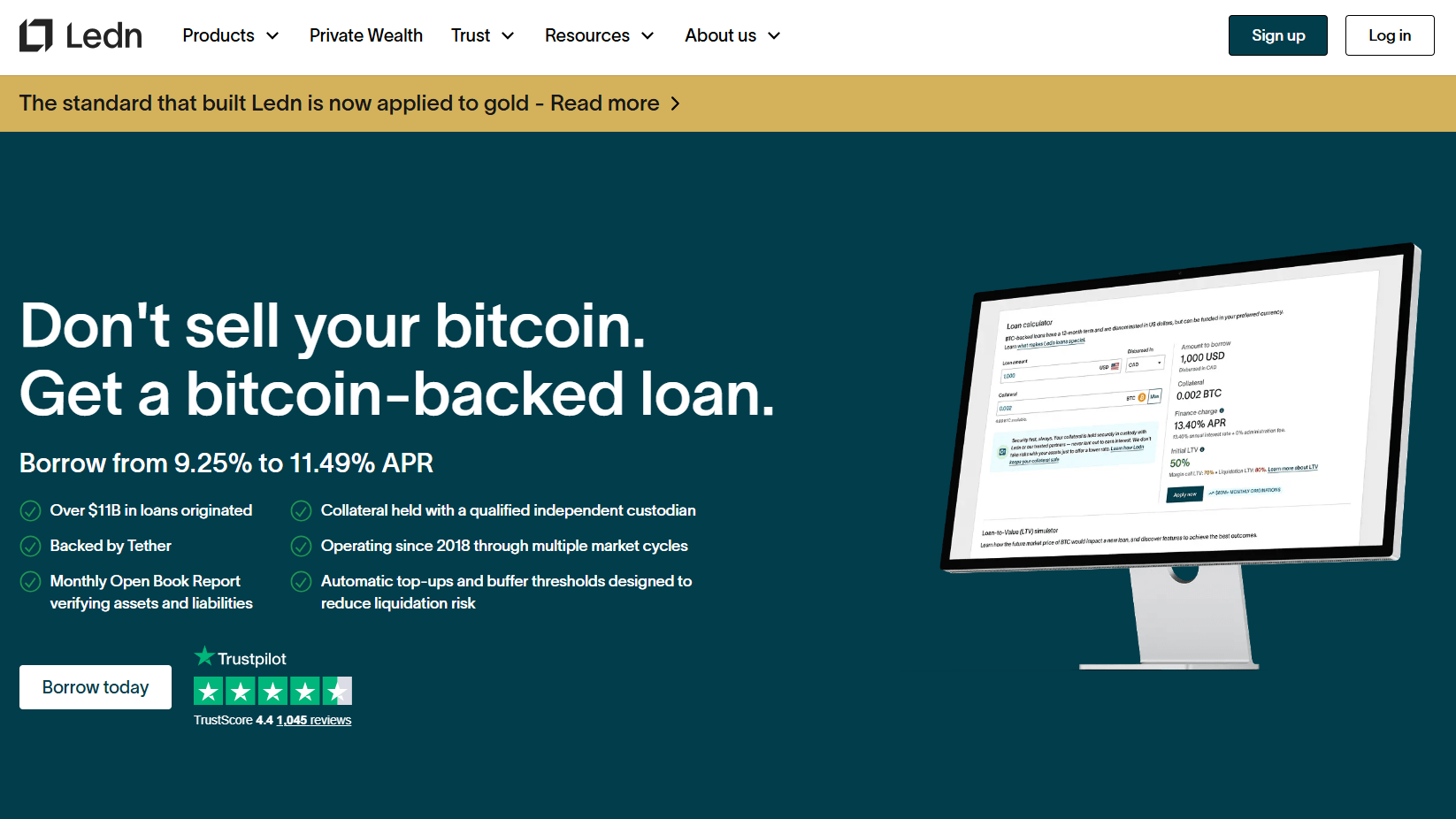
Loans start at US$500 and you’ll need at least US$1,000 of Bitcoin as security. Interest runs 7.99% to 9.49%, or 9.25% to 11.49% APR, tiered by loan size. Loans open at 50% LVR with a margin call at 70% and liquidation at 80%, which gives you a bit more headroom compared to most Aussie providers.
Ledn also states that your security is never lent out to earn interest for their company, which may be a valuable commitment for some users.
| Regulatory status | No Australian licence |
| Security accepted | Bitcoin |
| Loan amounts | From US$500 |
| Interest rate | 7.99% to 9.49% (9.25% to 11.49% APR) |
| Maximum LVR | 50%, margin call 70%, liquidation 80% |
| Funding time | Typically within 24 hours |
| Early repayment fee | Not published |
| Custody | Stated as not lent out |
6. Nebeus

Nebeus is a European platform offering loans alongside a crypto exchange and a renting product. It accepts more than 15 different assets as security, offering more choice than most, though there’s a catch for Australians.
Loans are denominated in euros or USDC, so you carry exchange rate risk on top of crypto-backed loan risks too. Your security sits with BitGo under institutional custody, with Lloyd’s of London cover. Nebeus is MiCA-authorised in Spain but holds no Australian licensing.
| Regulatory status | MiCA authorised by Spain’s CNMV, registration D664. No Australian licensing. |
| Security accepted | Bitcoin, Ethereum, Solana, XRP and 15+ others |
| Loan amounts | EUR 50 to EUR 10 million |
| Interest rate | 4% to 12.5% depending on product |
| Maximum LVR | 65% interest only, up to 70% flexible |
| Funding time | Not published |
| Early repayment fee | Not published |
| Custody | BitGo, Lloyd’s cover |
7. Binance
Binance is one of the biggest crypto exchanges in the world and offers a suite of products, include a crypto-backed loan feature. The platform’s Australian history is complicated, which makes it important to stay updated on Binance’s treatment Down Under and any news around its services.
ASIC cancelled Binance Australia Derivatives’ financial services licence in April 2023, and futures, options and leveraged tokens have been off the table for Australians since 2021. Spot trading was never affected, although AUD deposits and withdrawals stopped in June 2023 and came back on 16 January 2026 through PayID and bank transfer.
The loan product itself is overcollateralised and runs on LTV bands rather than a fixed term, with the thresholds published on their platform. Generally, the starting point is 65% LTV on USDT collateral, with a margin call landing at 75% and liquidation occuring at 83%, atop a 2% liquidation fee on the loan. Rates are variable and update every minute, so what you see quoted is not what you will necessarily pay for the life of the loan.
Loans are open to eligible Australian users through Binance Australia, and our own step-by-step guide walks through the Flexible Loan, the LTV slider, margin calls and liquidation. Fixed-rate and 30-day Lite options sit alongside the flexible product.
| Regulatory status | AUSTRAC-registered DCE. No Australian credit licence. Derivatives AFS licence cancelled April 2023. |
| Products | Flexible, fixed-rate and 30-day Lite loans |
| Security accepted | Wide range, varies by market |
| Loan amounts | Not published |
| Interest rate | Variable, updated every minute |
| Maximum LVR | 65% initial, margin call 75%, liquidation 83% |
| Funding time | Not published |
| Early repayment fee | None published. 2% liquidation fee applies |
| Custody | Held by Binance |
Decentralised protocols
The four options below aren’t certified lenders. Nobody assesses your application, no Australian licencee stands behind them, and rates move continuously instead of being quoted upfront. Liquidation is automatic with no notice period, and the potential delicacy of smart contracts introduces another risk that centralised lenders do not typically have.
8. Aave

Aave is an open-source, non-custodial lending protocol. Its DeFi lending program allows you to deposit crypto into a pool and borrow against it, with the rate you pay moving depending on how much of that asset is available. If you’re borrowing something in short supply, it costs you more. Because smart contracts automate transactions, the protocol can liquidate your assets automatically if your position weakens beyond a certain point.
| Type | Decentralised, non-custodial lending protocol |
| Regulated in Australia | No |
| Interest rate | Variable, set by supply and demand |
| Liquidation | Automatic and on-chain, no notice |
| Custody | Non-custodial |
9. Compound

Compound describes itself as an algorithmic, autonomous interest rate protocol. In practice you’re lending into, and borrowing from, a pool rather than a person. Like many other algorithmic lending protocols, rates are determined by how heavily each market is being used. Governance sits with holders of the COMP token, and you can borrow against a range of assets including Ether and DAI.
| Type | Decentralised, autonomous interest rate protocol |
| Regulated in Australia | No |
| Interest rate | Variable, set by market utilisation |
| Liquidation | Automatic and on-chain, no notice |
| Custody | Non-custodial |
10. Alchemix

Alchemix has a relatively unique take on crypto-backed lending – your loan repays itself. Essentially, you deposit crypto as security, that deposit earns yield, and the yield pays down the debt over time without you making a repayment.
Because the debt is backed by your own deposit rather than set against a market price, there’s no liquidation risk in the conventional sense. Alchemix v3 launched in May 2026, widening the assets it accepts and routing deposits to yield sources including Yearn and Aave.
| Type | Decentralised self-repaying loans |
| Regulated in Australia | No |
| Interest rate | None. Yield on the deposit repays the debt |
| Liquidation | No conventional liquidation |
| Custody | Non-custodial |
Services you may see listed elsewhere
There are several lenders that may still turn up in Australian search results and comparison guides even though you can’t actually use them.
- FiFit has closed down and its website is gone.
- Summer.fi has wound down. The app is deactivated and the protocol is withdraw-only, so existing users can exit positions but nobody can open one.
- Helio is no longer running, after ASIC took action over a false claim that it held an Australian credit licence.
- Bitcoin Dealers now only buys and sells crypto for cash, with no lending product published.
If you find a guide recommending any of those without qualification, check how recently it was updated.
Risks before you borrow
Crypto-backed loans can be a useful tool, but they do come with unique risks and considerations. These loans are quick and usually skip the credit check, because they are secured by your crypto rather than your income and serviceability.
Perhaps the biggest trade-off for this model is liquidation risk. If your security falls in value, your LVR climbs – and if it moves above a set threshold the lender can sell it. Australian providers generally issue a default notice somewhere above 60% LVR on Bitcoin and give you around 30 days to fix it. Decentralised protocols will often just liquidate with no notice at all.
Custody is the second consideration, just like when holding your crypto assets on an exchange. It’s worth asking who holds your security and whether the provider states it isn’t lent out. Rehypothecation, where a lender re-lends the collateral you deposited, is what turned several international crypto lender collapses in 2022 into total customer losses.
Before taking on a crypto-backed loan, it’s also relevant to investigate costs beyond just the headline interest rate, as origination and liquidation fees can quickly add up. Tax can also be a bit convoluted when it comes to these products, so it may be valuable to engage a professional with experience in the digital asset sector. The ATO publishes guidance on crypto assets which can give you a basic overview.
One last thing on licensing. AUSTRAC registration is an anti-money-laundering obligation and says nothing about a lender’s solvency or conduct. An Australian Credit Licence is a higher bar. Neither one protects your funds if the lender fails.
This guide is general information only and is not financial advice.
Frequently asked questions
Are crypto loans legal in Australia?
Yes. Providers dealing in crypto have to register with AUSTRAC, and consumer lending generally requires an Australian Credit Licence. A provider should tell you who’s providing the credit and under which licence.
How much can I borrow against my Bitcoin?
Australian providers generally lend up to 50% of what your Bitcoin is worth. Ethereum is usually capped lower at around 40%, and XRP lower again.
What happens if Bitcoin drops after I take the loan out?
Your LVR rises. Australian providers generally issue a default notice somewhere above 60% and give you around 30 days to top up your security or make a repayment. Global lenders tend to allow more room. Decentralised protocols often liquidate automatically with no notice.
Do crypto loans require a credit check?
Usually not, because the loan is secured against your crypto rather than your income. That’s why funding is often same day.
Do I pay tax on a crypto collateral loan?
Possibly. Providing crypto as security may have capital gains consequences depending on the loan terms, and wrapping Bitcoin into WBTC can be a separate CGT event. If your security is sold to cover the loan, that sale is a CGT event.
Can I get a crypto loan in Australian dollars?
Yes. The Australian providers here fund straight to an Australian bank account. Ledn lends in US dollars and Nebeus in euros or USDC, which leaves you carrying exchange rate risk on top of everything else.

Author